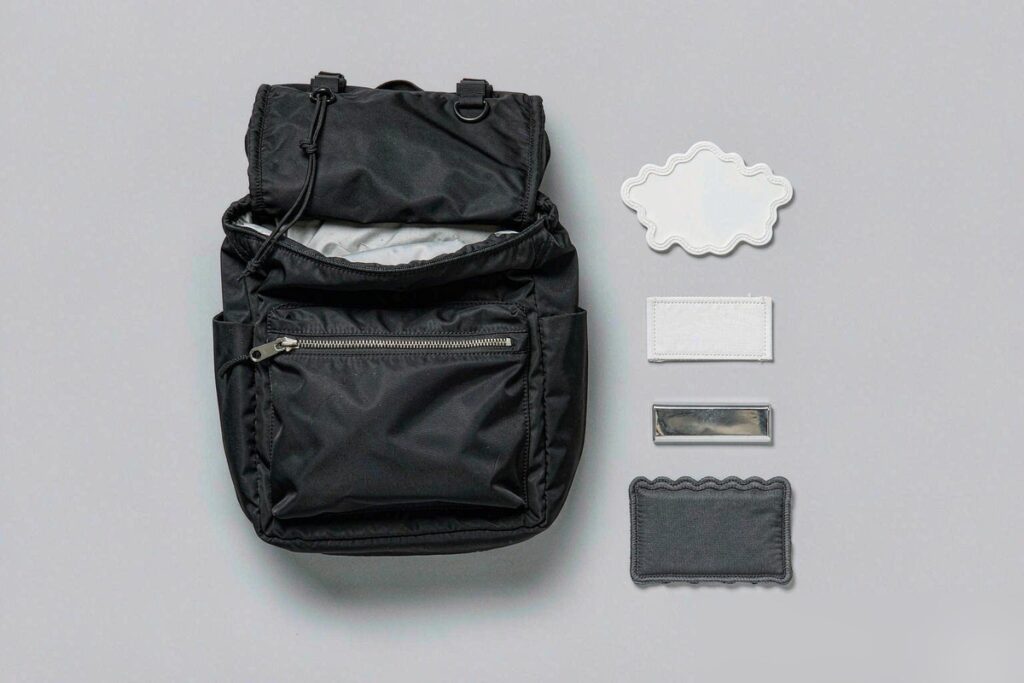
Custom Logo and Branding Options for Bags: Embroidery, Metal Plate, Woven Label and Silicone Patch
Once the bag structure is agreed, the next question buyers always ask is how to put their logo on it — and this is where a lot of first samples go wrong. The same artwork can look premium on one bag and cheap on another, purely because the branding method didn’t match the fabric, the price point or the volume. Here are the six options we run most often, and how to choose between them.
1. Embroidery
The default for fabric bags. Your logo is stitched directly into the panel, so it survives washing, abrasion and years of use — which is why outdoor, tactical and promotional bags almost always use it.
- Best for: nylon, oxford, polyester and canvas panels
- Watch out for: fine detail and small text. Anything under about 4 mm high, or a logo with thin strokes, will fill in and become unreadable. We usually ask for a simplified stitch version below that size.
- Cost driver: stitch count. A 6,000-stitch logo and a 14,000-stitch logo are not the same price.
2. Woven label
A woven label is produced separately and sewn on, which means the detail limit is far more generous than embroidery — small text, fine lines and multi-colour graphics all hold up. It is the standard choice for a neat, consistent brand mark on a mid-range bag.
- Best for: fine or multi-colour logos, brand labels on the front panel or inside the bag
- Options: centre-fold, end-fold, straight cut, with or without a heat-cut edge
- Note: adds a small per-piece cost plus a label MOQ, usually separate from the bag MOQ
3. Metal nameplate or hardware logo
A zinc alloy plate or a cast-metal zipper pull turns a plain bag into a retail-looking product instantly. It reads as quality and it is the option most often chosen for business and travel ranges.
- Best for: laptop backpacks, carry-on trolleys, premium commuter bags
- Watch out for: tooling cost. A new metal mould is a one-off investment and has its own (higher) minimum. Reusing a stock mould with your logo engraved is much cheaper.
- Finishes: brushed nickel, antique brass, matte black, gunmetal, gold
4. Silicone or PVC patch
A moulded rubber patch gives a crisp, bold, slightly technical look that works especially well on tactical and outdoor bags. It is durable, water-resistant and handles solid shapes better than fine detail.
5. Heat transfer print and screen print
The cheapest way to cover a large area — full-colour gradients, photographic artwork and large promotional runs. Print sits on the surface rather than in it, so it is the least abrasion-resistant option; we recommend it for light-use bags and volume promotional programmes rather than for a bag that gets dragged around a jobsite.
6. Embossed or debossed patch
For a leather or PU look, an embossed patch gives a quiet, premium brand mark with no added colour. It suits minimal business collections.
How to choose, in one line
- Heavy outdoor use → embroidery or silicone patch
- Fine or multi-colour logo → woven label
- Premium retail look → metal nameplate or embossed patch
- Large area, tight budget → heat transfer print
- Small start-up run → embroidery or a stock mould with your logo engraved
What to send us with your enquiry
To quote branding accurately the first time, we need four things: your logo as a vector file (AI, EPS or SVG — not a screenshot), the exact placement and size on the bag, the fabric the logo will sit on, and your target quantity. If you only have a low-resolution image, send what you have and our team will redraw it and confirm the smallest size at which it still reads clearly.
We produce branded sample panels before bulk production, so you approve the real stitch density, label colour and metal finish rather than a mock-up. Send us your artwork and we will come back with two or three branding combinations and their cost impact on your unit price.
Related: Backpack OEM Sourcing in 2026 — From Brand Brief to Bulk Order