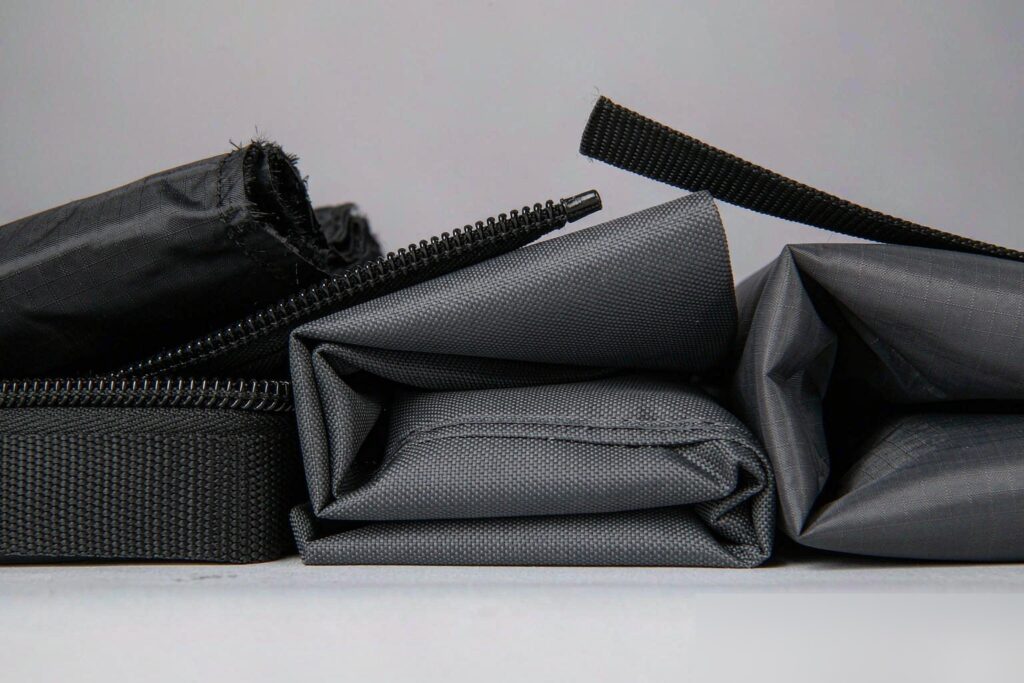
Nylon vs Oxford vs Polyester: Choosing Backpack Fabric in 2026
Every backpack enquiry we receive eventually lands on the same question: which fabric should the bag be made from? The honest answer is that there is no single best fabric — there is only the fabric that matches your price point, your climate, your weight target and your customer’s daily use. This guide compares the three workhorses of bag manufacturing — nylon, oxford and polyester — on the criteria that actually decide a bulk order.
Start with the four decisions that drive fabric choice
- Abrasion exposure — is the bag thrown on concrete daily, or carried from a car to an office?
- Weight target — a 40L hiking pack and a business laptop pack have very different fabric budgets.
- Water performance — light rain resistance, or a full afternoon in a downpour?
- Surface look — matte technical, crisp woven structure, or a soft hand feel for retail shelves.
Nylon: the lightest strength-per-gram option
Nylon has the highest tensile strength per gram of the three, which is why it dominates hiking and technical packs. Denier tells you the yarn weight: 210D nylon is light and packable, 420D is a solid all-round commuter fabric, and 900D–1000D nylon is what you specify when the bag has to survive scrapes against rock, trolley handles or truck beds.
Ripstop nylon adds a visible grid of thicker yarn every few millimetres. That grid stops a tear from running — a small puncture stays a small puncture instead of opening into a long split. For tactical and paintball bags this is close to mandatory.
Trade-offs: nylon is the most UV-sensitive of the three and, in plain unfinished form, the least water-resistant. Both problems are solved at the finishing stage rather than the fabric stage.
Oxford: the value workhorse for structure and hardware
Oxford is a basket-weave fabric, most often woven in polyester or nylon filament. Its visible crosshatch texture hides scuffs well, and because the weave is dense and inexpensive at heavy deniers, oxford is the default for wheeled tool bags, trolley tops and any bag with rigid panels or a reinforced base.
600D oxford is the industry standard for general luggage. 1680D oxford is noticeably heavier and stiffer, and is what we recommend for tool trolleys, where the bag is dragged, stacked and loaded well past the weight most backpacks ever see.
Polyester: the colour-holding, cost-stable choice
Polyester holds printed colour more consistently than nylon, resists UV better, and absorbs less water in its fibre core — so it dries faster. It is the sensible choice for business and daily laptop bags, where the requirement is a flat, even, corporate look in a stable colour across a multi-year programme.
Polyester has slightly lower tear strength than nylon at the same denier, so we usually pair it with a heavier backing, a laminated lining, or an oxford base panel where the wear points are.
Comparison at a glance
- Strength per gram — Nylon > Polyester > Oxford (but oxford wins on cost at heavy denier)
- Abrasion resistance — 1000D nylon > 1680D oxford > 600D oxford ≈ 600D polyester
- Water behaviour — all three need a PU or PVC backing coating; nylon dries slowest
- UV stability — Polyester > Oxford > Nylon
- Colour matching on repeat orders — Polyester > Oxford > Nylon
- Relative cost — 600D oxford < 600D polyester < 420D nylon < 1000D nylon
Finishing matters more than the fibre name
A 420D fabric with a good PU backing and taped seams will out-perform a 900D fabric with none. Before sampling, we always agree on four finishing points with the buyer:
- Backing coating — PU (flexible, softer) or PVC (heavier, cheaper, stiffer)
- Water repellency — a DWR finish, or a coated + seam-taped construction for genuine rain protection
- Hardware — YKK zippers and heavy-duty webbing are the two components that most often fail first on cheap bag builds
- Reinforcement zones — base panel, strap anchors and handle attachment points
A practical recommendation by bag type
- Outdoor hiking pack — 210D or 420D ripstop nylon, PU backing, seam-sealed
- Tactical / paintball pack — 900D–1000D nylon with MOLLE webbing and reinforced base
- Daily laptop backpack — 600D polyester or 420D nylon, matte finish
- Wheeled tool bag — 1680D oxford body with a moulded or reinforced base
- Travel rolling duffel — 600D polyester or 420D nylon with a coated lining
If you already know your target retail price and your MOQ, we can shortlist two or three fabric and hardware combinations inside one working day and send physical swatches for approval. Send us your sketch, reference sample or spec sheet and our pattern team will turn it into a production-ready CAD drawing.
Next: Backpack OEM Sourcing in 2026 — From Brand Brief to Bulk Order